Most businesses know they could be performing better.
Few know exactly where the breakdowns exist.
The Revenue Pipeline Diagnostic™ helps identify hidden revenue leakage, operational bottlenecks, and process inefficiencies across the seven stages of your revenue ecosystem so you can focus on the improvements most likely to create measurable impact.
Many organizations generate consistent demand but fail to convert it efficiently due to breakdowns within their revenue system.
Common issues include:
Individually, these issues may appear minor.
Combined, they can significantly reduce conversion efficiency, suppress growth, and create substantial revenue leakage throughout the business.
Revenue is not created by a single department, platform, campaign, or employee.
It is created by a series of interconnected systems working together to move prospects through your revenue ecosystem.
When one stage underperforms, the effects often ripple throughout the rest of the system.
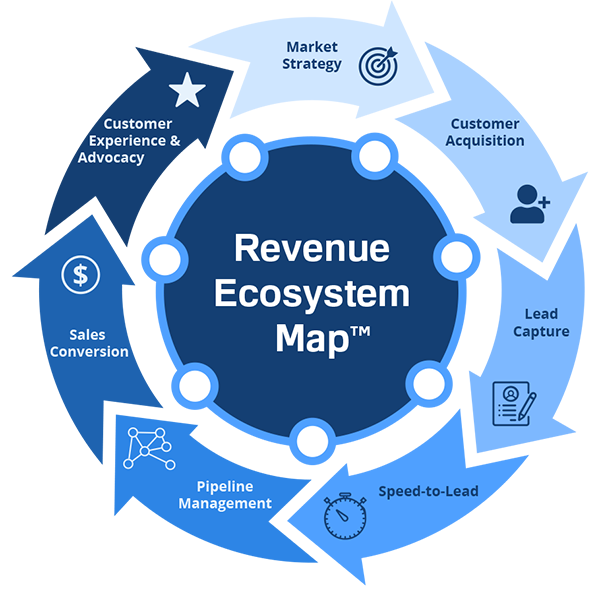
The Revenue Ecosystem Map™ provides a structured framework for understanding how revenue flows through your organization and where operational friction may be limiting performance.
The 7 Stages:
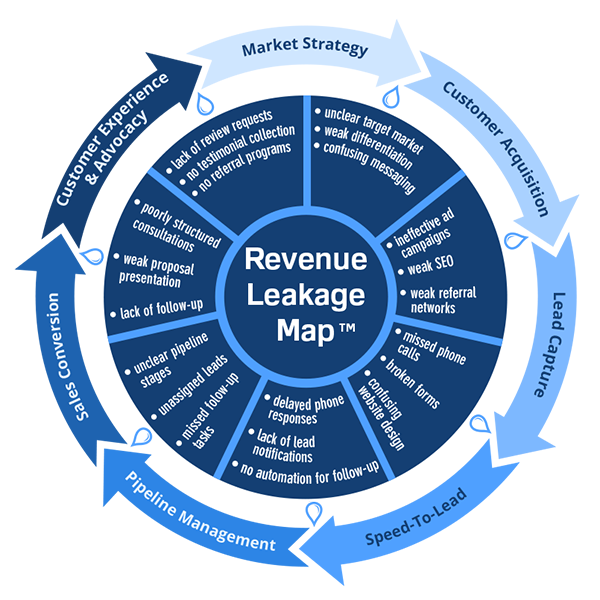
Revenue is rarely lost in one obvious place.
More often, it is lost between stages of the system.
A delayed response. A missed follow-up. A weak qualification process. A stalled opportunity.
Over time, these small inefficiencies compound into significant revenue leakage.
Most businesses recognize symptoms.
Few understand where the underlying causes exist—or how much those inefficiencies may be costing them.
This is not a general consultation.
The Revenue Pipeline Diagnostic™ is a structured analysis designed to evaluate how your organization captures, manages, and converts demand across all seven stages of the revenue ecosystem.
The objective is to identify operational bottlenecks, process breakdowns, conversion constraints, and opportunities for improvement.
The result is a clear understanding of:
| Current System | Optimized System | |
| Monthly Leads | 200 | 200 |
| Close Rate | 20% | 25% |
| Avg Client Value | $5,000 | $5,000 |
| Monthly Revenue | $200,000 | $250,000 |
This improvement comes from optimizing your system — not increasing marketing spend.
The question is not whether revenue is being lost — it’s how much, and where.
Your responses have been evaluated across the seven stages of the revenue system to identify areas where operational inefficiencies may be reducing performance.

Your responses suggest that your business has strong systems in place across most stages of the revenue ecosystem.
However, even strong systems often contain hidden inefficiencies that reduce scalability, limit conversion efficiency, or suppress revenue growth.
At this level, the opportunity is usually not fixing obvious breakdowns — it is identifying the few high-impact areas where optimization can produce disproportionate gains.
Your results indicate that your revenue system has a solid operational base, but there are likely several stages where inefficiencies are reducing overall performance.
Businesses in this range often experience inconsistent follow-up, unclear pipeline accountability, slower response than expected, and underused referral and review opportunities.
These issues may not stop growth entirely, but they often reduce conversion rates and leave meaningful revenue on the table.
Your results suggest that multiple stages of your revenue system may be underperforming.
At this level, businesses are often generating demand but failing to convert it as efficiently as they could due to breakdowns in lead handling, speed-to-lead, pipeline management, or conversion processes.
These kinds of inefficiencies frequently result in measurable lost revenue even when lead volume appears healthy.
Your responses indicate that there may be substantial inefficiencies across multiple stages of your revenue system.
Businesses in this range often experience missed inbound opportunities, weak pipeline visibility, delayed lead response, inconsistent follow-up, and poor conversion discipline.
This means that a meaningful percentage of available revenue may be slipping through the system before it ever becomes a client.
Based on your responses, your system appears to be operating at approximately 0% efficiency, suggesting roughly 0% potential revenue leakage risk across the system.
This does not mean that exact revenue is being lost. It means there are likely operational inefficiencies reducing how effectively your business converts demand into revenue.
The Revenue System Self-Assessment™ can help identify where inefficiencies may exist across your revenue system.
The Revenue Pipeline Diagnostic™ goes deeper.
It evaluates the underlying causes of revenue leakage, conversion friction, operational bottlenecks, and sources of revenue leakage across the seven stages of your revenue ecosystem.
Whether you completed the assessment above or arrived here ready to move forward, the next step is identifying what is actually limiting performance and which improvements are most likely to create measurable impact.
The Revenue Pipeline Diagnostic™ is designed to provide clarity, objectivity, and actionable insight.
Depending on scope and business requirements, deliverables may include:
The objective is not simply to identify problems.
The objective is to identify the highest-leverage opportunities for improvement and provide a structured path forward.
If your business is generating leads but experiencing inconsistent conversion, slow response times, unclear pipeline visibility, operational bottlenecks, or unpredictable revenue performance, the Revenue Pipeline Diagnostic™ can help identify where revenue is leaking and what improvements are most likely to create measurable impact.
"*" indicates required fields
What is the difference between the Revenue System Self-Assessment™ and the Revenue Pipeline Diagnostic™?
The Revenue System Self-Assessment™ is a self-guided evaluation designed to identify potential areas of operational friction and revenue leakage across your revenue ecosystem.
The Revenue Pipeline Diagnostic™ is a structured analysis that investigates the underlying causes of those issues. It provides a stage-by-stage assessment of your revenue system, identifies operational bottlenecks, and prioritizes improvement opportunities based on potential business impact.
I received a low score. Does that mean my business is failing?
No.
Many successful businesses continue to grow despite significant inefficiencies within their revenue systems.
A lower score simply indicates there may be opportunities to improve conversion efficiency, customer flow, operational alignment, or revenue performance. The purpose of the assessment is to identify potential sources of revenue leakage and operational friction—not to judge overall business quality.
What if I received a high score?
High-performing businesses often benefit the most from diagnostic work.
When a business already has strong fundamentals, even small improvements in conversion rates, lead handling, pipeline management, or customer retention can produce disproportionately large revenue gains.
The diagnostic helps identify those high-leverage opportunities.
How long does the Revenue Pipeline Diagnostic™ take?
The diagnostic process varies depending on business complexity, the number of systems involved, and the availability of supporting information.
Most engagements begin with a discovery conversation followed by a structured review of the seven stages of the revenue ecosystem.
Specific timelines are discussed during the initial consultation.
What types of businesses are a good fit?
The Revenue Pipeline Diagnostic™ is generally most valuable for businesses that:
Businesses at various stages of growth can benefit, provided there is enough activity to evaluate system performance meaningfully.
Will I receive recommendations or just a report?
The objective is not simply to identify problems.
The Revenue Pipeline Diagnostic™ is designed to provide actionable findings, prioritized observations, and practical recommendations intended to help improve revenue system performance.
The focus is on identifying where revenue leakage exists and determining which improvements are likely to create the greatest impact.
Do I need to complete the Revenue System Self-Assessment™ first?
No.
The self-assessment is recommended because it provides a useful starting point and helps identify potential areas of concern.
However, businesses may schedule a Revenue Pipeline Diagnostic™ without completing the assessment.
How is this different from a traditional marketing audit?
Traditional audits typically focus on a single department, channel, platform, or campaign.
The Revenue Pipeline Diagnostic™ evaluates how revenue moves through the entire revenue ecosystem—from Market Strategy and Customer Acquisition through Customer Experience & Advocacy.
The goal is to identify how different stages interact and where friction may be affecting overall performance.
What deliverables are included?
Depending on the scope of the engagement, deliverables may include:
Specific deliverables are discussed before the engagement begins.
What happens after I submit the diagnostic request?
After your submission is received:
Not every business requires the same level of analysis, so the initial review helps determine the most appropriate path forward.
Most businesses recognize symptoms long before they understand the underlying causes.
Whether you completed the Revenue System Self-Assessment™ or arrived here directly, the next step is determining where revenue is leaking, what it may be costing your business, and which improvements are most likely to create measurable impact.